Exploring spirituality somewhere between the Emerald Isle and the Black Land....
Showing posts with label Kemetic. Show all posts

Wednesday, April 15, 2015

The Colors of Wepwawet

Perhaps the biggest misconception about Wepwawet is that he is depicted as a white or grey jackal (or jackal-headed man), while Anubis is depicted as a black jackal (or jackal-headed man). Yet historically, Wepwawet and Anubis are both depicted as black jackals. I think the pervasiveness of this bit of misinformation comes from a desire to be able to clearly and easily differentiate between Wepy and Anubis. Convenient as it would be, a white/grey Wepwy just isn't true to his iconography. In the interest of clearing this up, I wanted to share something I saw on tumblr forever and a half ago, which was originally written by Bezenwepwy. This particular post reads:

"First off, I am going to point out that the late Terence DuQuesne, THE foremost expert on jackal deities, adamantly agreed with me that Wepwawet was not depicted as a grey or white jackal. Claims of such have very little basis in reality and for the most part seem to arise from some all too common oversights and misunderstandings.
The biggest of these misunderstandings seems to be the depictions of Wepwawet in the temple of Seti I in Abydos, where much of the relief retains colour except for Wepwawet’s head. But it is very important to stress that a colourless depiction does not equate to ‘white.’ It equates only to what it is. The overall lack of surviving black paint at that temple has been noted by scholars. From my reading, the fragility and poor adherence of the black seems to have been caused by a reaction between the pigment and the underlying plaster. This temple, along with others, were also subjected to archeological squeezes, conducted during a time when egyptologists didn’t really care that much about preservation. The poor survival rate of black pigment when it comes to temple reliefs isn’t just limited to Abydos either. And on those reliefs where the pigment on the face and/or body IS surviving? Yeah, it’s black.
The second major source of misunderstandings about Wepwawet’s colouration may come from the painted murals within tombs and decoration on funerary equipment. A) Tombs and sarcophagi do sometimes feature unusual colour schemes, so you might find green-skinned, yellow-skinned, or blue-skinned jackal deities. It tends to be consistent however, with no differentiation in colouration between Anubis, Duamutef, Wepwawet, etc, that I have noticed. B) Sometimes the pigment used as black in a particular tomb does now appear to be more grey, perhaps through degradation or just because it wasn’t painted on thickly enough or what-have-you. But that means that the grey is not really meant to be grey, it is meant to be black. There might be a grey Wepwawet, but other commonly black elements will also appear to be grey. This does not a grey Wepwawet make.
A friend of mine brought up a third point when she noticed there are more depictions of Anubis with surviving pigment than there are of Wepwawet. She felt this probably has an impact on people’s perception of what colour Wepwawet is, and I agree that it may very well do! It is, however, another case of not misinterpreting 'colourless’ for 'is coloured something other than black.’ He would have originally been painted black. An interesting thing about depictions of Wepwawet is they are quite commonly found in areas where there is a greater exposure to the elements (such as temples) — as opposed to Anubis, who is often is much more sheltered locations such as tombs or inner rooms. It is only logical that the pigment would survive better in areas of less exposure. And, as I’ve implied, black does also seem to be one of the first colours to go when it comes to temple reliefs.
I must also say that I have yet to find a single instance/location where Wepwawet and Anubis are actually painted different colours, let alone enough examples to declare it as an established pattern. (As I pointed out, unusual colour schemes can and do happen but they should be considered anomalies. Or a contextual variant if there are enough examples.) It is therefore deceptive at best to say 'Anubis is painted black while Wepwawet is painted grey.’ I appreciate that a lot people have gotten this idea from Wilkinson’s 'Complete Gods and Goddesses of Ancient Egypt’ and so I actually contacted him about it awhile back. He had this to say to me: “My comment on Wepwawet was based simply on my own experience - that a number of examples I have seen (inasmuch as it is possible to tell that W. is intended) seemed to be grey or not to be painted black when color was otherwise present. On the other hand, looking now at what I wrote, I think that the implication that this is "usually” the case is due to a poor choice of words on my part. I believe that what I meant was that while Anubis is usually shown as black, W. is sometimes depicted as grey (or without black). It is interesting if you have not found any examples of W. that differ so from Anubis - perhaps it is a rarer phenomenon than I realized.“ (Sadly, we were not able to get into more specifics at that time.)
I have addressed the lack of black and also the occasional appearance of 'greyness’ in those situations where it is serving as a substitute for black or else is suffering from degradation or transparency. It seems relevant to add that green can also degrade to a quite greyish look and is a not uncommon skin-tone in funerary contexts due to its colour symbolism. The thing about grey as a colour is it does not have its own individual symbolism in AE art. It classifies as black. So it doesn’t even make any sense, when colour is always used in such a highly symbolic way, for the Egyptians to have distinguished Wepwawet as being grey while Anubis is black. It also comes into conflict with the fact that since the Old Kingdom, the vast majority of jackals, be they gods, spirits, or even just hieroglyphs, are painted in black."

Saturday, November 8, 2014

Wepwawet's Tambourine

I have long wanted a sistrum for ritual purposes. Problem is, I have neither the skill to make one of my own, nor the money to buy a nice one that I really like. So I did the next best thing and stole an idea from a friend of mine, who decorates tambourines with deity images. I bought a 10" tambourine and decorated it with acrylic paint, dedicating it to the super awesome Wepwawet. I made it for him not just for the fact that he's been my patron (for lack of a better word) lately, but also because according to Per-Sabu "Wepwawet was one of very few deities to have his own dedicated groups of both chantresses and dancers." This more celebratory side of Wepy isn't very well known, but it is reflected in certain epithets he has, such as the Lord of Jubilation, He With the Sweet Joy, and He Who Causes and Brings forth Goodness.

And here is the part where I show off Wepwawet's new tambourine. I painted him in a typical pose, as a jackal just standing there, being all stoic and cool. I put him on the "earth" hieroglyph with the shedshed at his forepaws, and put Nut stars all around the edge (because Nut, that's why). All in all, I think it makes a great stand-in for a sistrum!


Wednesday, May 28, 2014

My Ib

A few weeks ago I saw this video:


...And I thought, "That's cool! Kaif, get yourself a little ib pot thingy, and do all of the heka!"

While I probably could have gotten away with using any sort of container, it was very important for me to get one that at least somewhat resembled the ib symbol. So for a couple of weeks I kept an eye out for something suitable, but unsurprisingly, didn't find a finished product that was the right shape and size and price. And then I got impatient, so I did what I usually end up doing, and made my own.

For a dollar or two at a craft store, I found a small glass vase that had more or less the right shape, minus the handles. It was a little bigger than I would have liked, but it was the best I'd found so far. I took it home and covered the entire thing in air dry clay. It was a gamble, because I had no idea if the dried clay would stick to it or not, but luckily, in the end it did. (Huzzah!) I then added some handles to the body (again using air dry clay) and painted it a deep, rich red. Aside from being the color that ibs are usually portrayed in, red also happens to be my favorite color, so it has a bit of added meaning right there.

The result was this:


And here is a picture of my ib pot stowed safely on my shrine, with my Wepwawet amulet and ankh necklace draped around it:


Thursday, March 27, 2014

Wepwawet's Shrine

If any of you have been paying attention to my most recent posts, you will likely have noticed that I have developed a bit of a Wepwawet obsession. I encountered Wepwawet not too long after I became Kemetic and liked him right off the bat, but it wasn't until about a year ago that we started working together on a regular basis. Everything pretty much snowballed from there, and we've developed quite a rapport in that time; so much so that after much consideration, earlier this month I finally took the plunge and dedicated myself to him. That of course meant he got a fancy new shrine, which in turn meant that I had to take pictures and show it off.


Ta-da! Wepy's shiny new shrine!

As you can see, Nut gets her own little spot on his shrine. She's another deity that I've long adored, and as there are references to Wepwawet being Nut's firstborn, I thought it was fitting that she have a place with her son.


All lit up with candles and incense.

Monday, March 3, 2014

Polytheism 101: Ritual

The third post in my "Polytheism 101" series will cover the basics of ritual. Though I will be referencing certain Kemetic viewpoints in regards to ritual, the actions and ideas behind them will be the same for any practicing polytheist. I feel I should also note that though this series is called "Polytheism 101," the ideas and methods shared here can be applied to just about any Pagan path.


There are a number of actions that many polytheistic/recon rituals share, and I have listed them below. These are what I consider to be the basic steps to performing a ritual.

Calling the deity
Before starting your ritual, you may find that it helps to invite your deities to join you. Some people call them by playing an instrument, ringing a bell, singing, or chanting. Others say a simple prayer, such as "Sekhmet, O powerful One, please join me for this ritual." Many also find it fitting to greet the deity with a bow. You can do any or all of these things. The most I do is ring a bell and call the deity's name before bowing.

Lighting the candle
In a Kemetic sense, the candle flame is representative of the sun and therefore the victory of Ra as he emerges from the underworld (or the forces of ma'at as they defeat the forces of isfet). Lighting the candle is also symbolic of Zep-tepi, The First Time, when Ra (or Atum, or whichever creator deity floats your boat) came into being and everything began. This isn't too far off from the meaning of the ritual flame in other traditions. The flame establishes the beginning of the ritual as the beginning of something new and significant, and/or the establishment of something powerful and good over the symbolic darkness. If you want to say a prayer while lighting a candle, something like "As Shapsu rises over the horizon, I light this candle" or "I light this candle for you, O Morrighan. May it shine as victoriously as you" will do.

Offering the incense
I read somewhere - and I can't remember for the life of me where exactly - that that the Egyptian word for incense (senetjer) means "to make divine." Whether or not this is true, and whether or not you follow a Kemetic path specifically, that phrase is fitting. Incense marks a space and moment as being sacred, and is very much beloved by the gods. And if you are anything like me, it goes a long way in putting you in a ritualistic headspace. I think it's also worth noting at this point that while both a candle and incense can be given as offerings in and of them selves, they both serve the purpose of establishing sacred space. For this reason I consider them to be ritual tools as much as they are offerings. If you wish, you can say something along the lines of, "I offer this incense to you, O Wepwawet. May its scent please you."

Libations
Libations are liquid offerings which are poured into a dish or, if your ritual is outdoors, onto the ground itself. Wine is commonly used, but other liquors, water, or milk can also be used. Since my practice is primarily Kemetic, I use water. In this context, the libation represents the life-giving abundance of the inundation. Of course, the theme of abundance and refreshment still works with other pantheons. You can accompany your libation with a prayer like "O Dadga, I pour this libation for you, that it will rejuvinate you."

Giving the food offering
At this point, it is time to give the food offerings. I often accompany these offerings with a prayer. You can say something simple, such as "O Brighid, please accept these offerings. May they satisfy and strengthen you." Only a small amount of food is needed to give to the gods. If you are having a feast as part of your ritual, you may choose to offer the entirety of the feast to the gods, in which case you would still give them their own portion of food.

Ritual action
Now is the time to perform your magic, meditate, pray, feast, or do whatever it is that you are performing the ritual to do. If consuming the food offerings is part of your practice, you will either eat them at this point, or wait until sometime after the ritual has concluded to return to the shrine and eat them. Kemetics call this "reverting the offerings," and only requires a simple prayer before you eat them, like "O Bast, receive your offerings from me." The majority of my rituals are done for the sole purpose of giving offerings to my gods, so I usually just take a couple of minutes here to pray, meditate, or just sit there quietly and enjoy the deity's company.

Closing the ritual
Kemetics know this as "removing the foot." Thank and bid farewell to the gods, extinguish the candle, and remove the libation and food offerings (or offering dishes if you have consumed them as part of the ritual action). If you intend to eat the offerings later, leave them at the shrine until you are ready to do so. Once you are ready to leave the shrine space, bow, then take a few steps backwards before turning away from the shrine.


And that's pretty much it. Hopefully now you're ready to perform your own rituals with confidence!


Other posts in the Polytheism 101 series include "Building a Shrine" and "Offerings."

Tuesday, January 28, 2014

Wepwawet, God of teh Shiny

After a long and perilous journey through the underworld, Wepwawet emerges victorious!

Or more accurately, after a long journey through customs, this beautiful bronze Wepwawet amulet/ritual item arrived in the mail yesterday. It was made for me by jackal junkie and all-round awesome person, Bezenwepwy.


Guyz. I love this so much I can't even words.
 

Monday, December 30, 2013

Wepwawet, God of teh Cute

I recently took up a new craft: needle felting. One of my first projects was this, a little Wepwawet doll. I still haven't decided if I'm finished with it yet or not, but he looks pretty darn cute in the meantime. Not too bad for a beginner, I think!


Wednesday, October 16, 2013

Polytheism 101: Offerings

The second post in my "Polytheism 101" series will cover appropriate offerings for various pantheons, and what to do with them after they have been offered. I feel I should also note that though this series will be called "Polytheism 101," the ideas and methods shared here can be applied to just about any Pagan path.


While the short answer to the question of what to offer the gods is "whatever you have to give," I'm betting that if you came here, you're looking for a more substantial answer. So here it is, my meatiest, Manwich-iest of answers:

There are three main places to turn to when figuring out what to offer the gods. The first is to look at the region your gods are from. If you follow Hellenic deities, you might want to offer Greek food. If you are Heathen, try Germanic or Scandinavian foods. Second, look to the myths and symbology of the god in question. At a ritual I once held for Sekhmet, an attendee brought some pomegranate infused beer because they read the story in which Sekhmet was pacified with beer dyed red with pomegranates. A cauldron could be given to Dadga or raven figurines to Odin, as those things have mythological significance to those gods. Lastly, as you continue your research, you'll find out what kinds of things are proven (or at the very least, likely) to have been offered in antiquity. From there, it becomes much easier to figure out suitable modern or local counterparts to give, which is especially important if some of these things aren't easily acquired (such as offering venison instead of gazelle meat).

If you are at a complete beginner, following a more obscure god/pantheon, or otherwise at a loss of where to start, there are luckily a number of things that make great offerings to give to any deity of any pantheon. I've found that vegetables, fruit (dried or fresh), water, fruit juice, bread, and alcohol are always a safe bet. As far as items go, incense, flowers, coins, and pretty stones or crystals are also great catch-all offerings. As you gain intuition and familiarity with your deity and their pantheon, it will go a long way in deciding what to give.

As far as the disposal of offerings go, composting or burying them is probably the most common thing to do, though burning or sinking them also works. When disposing of offerings, it is important that you to be mindful of what you have offered and how you are disposing of it. For example, if you offer chocolate, don't leave it lying around in a park where someone's dog could find and eat it, and don't burn an offered item if it could produce harmful fumes. What exactly you do with them may also be determined by where you live; I live in an apartment, so burning or burying anything on the grounds is out of the question, and I'm well out of walking distance from the nearest lake or river, so I just put natural (e.g. flowers, rocks, etc.) and edible offerings under a tree for the wildlife to take. (As I said before, if you are going to do this, be mindful. You don't want to leave something that will make an animal sick!) Just use common sense, and you'll be fine.

The following is a list of more traditional offerings for the Irish, Kemetic, and Canaanite pantheons. I've compiled it from my own research, as well as a bit of personal experience. Hopefully it will serve as a good starting point for you as you continue to build your own practice.


Irish Celtic offerings

Edible offerings: Alcohol is a favorite among the Déithe. Mead, beer, and whiskey are the definite forerunners, though I've known them to enjoy wine or hard cider. Apple juice and milk are great non-alcoholic alternatives. Beef, pork, and salmon are ideal meat offerings. Apples, hazelnuts, cheese, and honey (or pretty much anything with honey in it) are also great choices, though I have found that hearty foods in general tend to go over well with the Déithe.

Incense: Juniper incense seems to be well-loved, as well as cedarwood and sage. I've also had great results with cinnamon, amber, and cedarwood. Basically, anything woody and earthy is a good choice.

Items: Flowers and other natural items, or things carved from stone or wood are great. Weapons, real or miniature, are popular with warrior deities. As humans were sacrificed in ancient Ireland, human effigies are a suitable and powerful offering, though in my opinion, they are best saved for special occasions.

Food offered to the Déithe likely was not eaten, so you may want to avoid doing so. The best way to dispose of any offering to them is to burn, bury, or sink it in a body of water. Man-made items should be destroyed (broken or otherwise rendered useless, as was done back in the day) then burned, buried, or sunk. However, since items won't spoil, I find that it is sometimes acceptable to leave them on the shrine for an extended period of time first. (Devotional jewelery is my exception to this rule; such items I keep and wear indefinitely.)


Kemetic offerings

Edible offerings: As far as food offerings go, it could be said that the Netjeru have simple tastes. Bread, water, and beer are are the most basic, yet most ideal offerings. Beef, milk, onions, dates, figs, and wine are also appropriate. Game such as gazelles was also offered, so I think deer or elk could make a suitable substitution.

Incense: Frankincense and myrrh were commonly offered, and are probably the best choices if you can get your hands on some, though the Netjeru seem to love resins in general. I've also had good results with lotus, cedar and sandalwood, jasmine, and fig. When offering incense, the most important thing to keep in mind is that some brands use dung as a binder. These should not be given to the Netjeru, as dung is considered impure for ritual purposes (for obvious reasons; I mean, it's poo). I've put together a list of pure incense brands at the end of this post.

Items: The ankh, ib (heart), feather of ma'at, and udjat (Eye of Horus) are all things that were offered to in ritual. Jewelery and perfume, or pretty much anything that's pretty will be enjoyed by the Netjeru. For as simple as their tastes in food offerings can be, when it comes to stuff, they enjoy fine things.

Food offered to the Netjeru was eaten by the priests, so if it is up to you if you would rather eat or bury them. Items which were offered were also used by priests, so you can use them yourself, in honor of the god(s) it was offered to, leave them at the shrine, or bury them. Fire was typically used for banishments or execrations, so I wouldn't burn anything that was given to the Netjeru.

Follow this link if you would like to read more about Kemetic offerings.


Canaanite offerings

Edible offerings: Wine, figs, pomegranates, dates, grapes, hummus, olive oil, flatbread, beef, lamb, and goat are some of the best things to offer. Do not offer pork to the Iluma; it wasn't offered in antiquity, and is likely considered inferior or impure. They prefer farmed meat over wild game.

Incense: When it comes to incense, the Iluma seem to share many of the same tastes as the Netjeru. Myrrh and frankincense are ideal, as are other resins and floral scents. Offerings of incense to the Iluma  also carry the same requirement of purity as those for the Netjeru.

Items: Perfume or olive oil infused with essential oils are always enjoyed by the Iluma. Flowers, art, and jewelery make great offerings as well.

Disposing of Canaanite offerings is much the same as with Kemetic ones; priests used or ate what was offered, and you may choose whether or not to do so yourself. The main difference is that Canaanites performed burnt offerings, so burning them is an option.

If you are interested in reading more, this post has an in-depth account of offerings preferred by the Iluma.


Pure incense brands:


Other posts in the Polytheism 101 series include "Building a Shrine" and "Ritual."

    Friday, September 27, 2013

    Papyrus Painting - Wepwawet

    My latest painting is of Wepwawet. All of the Netjeru love gold, but I've long had the feeling that Wepwawet is also extremely fond of bronze. So naturally, I used lots of bronze-colored paint in this picture.

    I may have overdone it a little....


    Thursday, September 12, 2013

    Polytheism 101: Building a Shrine

    This is to be the first post in my "Polytheism 101" series. As the title says, it will cover the basics of putting a shrine together. I feel I should also note that though this series will be called "Polytheism 101," the ideas and methods shared here can be applied to just about any Pagan path.

    How you decorate a shrine is largely a personal matter. Your own taste, which tradition you follow, and which gods you honor - if any in particular - will determine what exactly your shrine ends up looking like. Big or small, extravagant or simple, the sky's the limit. So my focus here will be about the various items that are used for ritual and devotional purposes.

    Items that are commonly used for a shrine are a pitcher and bowl for libations, a small dish and cup for food offerings, an incense holder, a candle holder, a bell (or a sistrum or drum), and a deity image or religious symbol. I set up these items as an example in the following picture:


    I set up this sample shrine on an empty spot on my dresser. For your own shrine, any such clear surface will do, but I do prefer my shrines to have an entire surface all to themselves (such as on a shelf) to ensure that any clutter doesn't encroach on the shrine space. As for items, for my libation bowl and pitcher, I used a cruet that I bought at a supermarket for $3, and an onyx bowl that was given to me as a gift. For an offering dish, I just re-purposed a saucer from my cupboards. The tea light candle holder and "incense holder" (it's just a pretty dish I liked and put one of those Morning Star incense tiles in it) were purchased at a craft store for $1 each. The offering glass was a thrift store find for about a dollar, and as you can see, the deity image is just a picture of Wesir that I printed from my computer. My splurge item is the bell, which I got at a local metaphysical shop for about $6 or $7. The reason I'm explaining where I acquired everything and for how much is to demonstrate that a shrine can be assembled easily and for little cost.

    I remember that as a young pagan, I would often read about all of the things one "needed" in order to practice a certain path or tradition successfully, and feel overwhelmed by them. Such lists (especially those for more Pagan/Wiccan leaning practices) are often quite long, and the task of acquiring so many things can be very daunting to anyone who is practicing casually or in secret, or who has a limited working space or tight budget. Yet the more experienced I became, the more practicality became my rule of thumb. You don't need a wand, special robes, or crystals. Even an athame can be left by the wayside when you have a perfectly good index finger to direct energy.

    Even my list, as short as it is, shouldn't be seen as a list of requirements that you absolutely need to be a decent polytheist. The items on this list are the things that have proven to be the most used in my own years of experience. But if you feel that you would rather offer a glass of water instead of making a libation, then obviously you can forgo the pitcher and bowl. If you would rather clap your hands or use your voice, then you can skip the bell. Even the deity image/symbol isn't a necessity, as not everyone finds visual foci useful.

    You can see more examples of shrines in my post about 'Anatu and Athtartu,  and in last year's posts about Wep Ronpet and the Day of Chewing Onions for Bast. There is also the website Shrine Beautiful, which features shrines, both simple and ornate, from many different paths.


    Other posts in the Polytheism 101 series include "Offerings" and "Ritual."

    Thursday, August 22, 2013

    The Ultimate Cocktail: Mixing Pantheons

    When I first started this blog, I thought I'd be writing a lot more about what it's like to follow two different paths at the same time (and now three, because back then I wasn't a Canaanite polytheist yet). It's pretty clear now that the reason that I only write about them separately is because I keep them separate in practice. It only makes sense that my blog would follow that same pattern. But here at long last, I have something that involves all three.

    One issue that pops up on various forums and groups is whether or not it is appropriate to follow multiple spiritual traditions or paths, and how to go about doing so. It is this issue that I'm going to address today.

    To anyone who has has read this blog before, it must be unsurprising to hear me say that I think it is absolutely appropriate to honor more than one pantheon of deities. I'm sure it is also unsurprising to hear me say that what I recommend is keeping your practices separate. The only real trick to this is keeping a separate shrine for each pantheon, and after that, tailoring your rituals to each specific path in regard to that path's gods, their mythology, and the culture from which they come.

    One of the most basic reasons I say this is because once you've separated everything, it's easier to get a sense of what works well for each pantheon, and which deities or practices (if any) mesh well. Another important thing to consider is that one thing that is acceptable to one pantheon's practice might be taboo in another. Blood, for example, can be a powerful offering to certain Celtic deities, but in certain Kemetic religions, blood is fairly widely considered to be an inappropriate thing to have at a shrine. Other such offerings include pork (which was never named in Canaanite texts as as an offering to the Iluma) or incense made with dung as a binder (which is a big no-no in both Kemetic and Canaanite traditions). Kemetic and Canaanite religions also often require some form of purification before ritual, whereas ritual purification isn't as commonly practiced in Celtic traditions.

    So let's say you're working with two different pantheons of deities, and you are keeping those paths completely separated. How do you make this work? How do you strike balance between them and give a fair share of your time and effort to each?

    Well, if you have a path that is primary, that pretty much solves the problem right there. You may only practice your secondary path as you see fit, or perhaps once every month or so. However, if that's not the case, one thing that works well is dividing ritual time evenly between the pantheons. For example, if the Netjeru get offerings one day, the next offering can be made to the Déithe. Or you can alternate between weeks or months (or whichever time period works for you), with the Netjeru getting all of the offerings and rituals for one month, and the Déithe getting all of the offerings/rituals the following month.

    The only issue with this is that every now and then you may feel the need, either on your end or the gods', to focus on one deity or pantheon for weeks or even months at a time. A pantheon might suddenly become primary (if one wasn't before), or whichever pantheon was primary might change for a while. For well over a year, I was focused very heavily on my Kemetic path, but once I established my Canaanite shrine, my path was almost exclusively dedicated to 'Anatu and 'Athtartu for about three months. In my experience, the gods tend to be quite understanding when it comes to realizing what you need at any point in time. Besides, another deity's turn probably won't be far behind. The key to this is that it requires a certain amount of attention and intuition to maintain this balance, to know when which god wants what when, but you'll get better at it as you go along.

    However, I know from experience that it's not always possible to have the space to set up two or three (or more) different shrines. And I'm sure there are also cases in which keeping them separate just doesn't work for an individual. If you want to mix different paths into a singular practice, the most important thing to keep in mind is what is considered acceptable to the deities (purification, blood, etc.), which I mentioned before. If I had a shrine to the Iluma and Déithe, I would refrain from offering "impure" incense at that shrine. I might not offer pork, either. Pig may make a wonderful offering for Celtic gods, but not so much for the gods of Canaan. If I felt I needed to give Mannanan Mac Lir some bacon, I might make a small, temporary shrine elsewhere, and offer it there. Again, attention and intuition are very important here. As you go along, the gods will let you know where the lines are.

    While I will freely admit that I don't get the appeal of mixing deities of different pantheons into one practice, the recon-snob in me can't make too much of a fuss about it, because it was done in ancient times. Greeks honored Heru and Anpu as Horus and Anubis, and Egyptians honored 'Anatu and Yamu as Anat and Yam. Moreover, the Greeks and Egyptians honored these gods within the religious contexts into which the deities were adopted. I know that there are plenty of discussions as to how appropriate doing a similar thing in modern times is, and I think there are good points on both sides. But in the end, I think that as modern polytheists, honoring our gods and having respect for them and their cultures is the most important thing.


    Wednesday, June 26, 2013

    Papyrus Painting - Mut

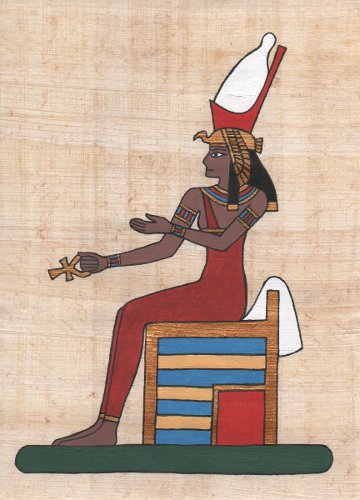
    A picture of Mut that I painted. I thought about putting a was scepter in her empty hand. I've not seen a picture of her holding one, but since she's a queen, I think it would have made sense. But in the end, I painted her so that she's holding out her hand in a summoning gesture, calling for her follower (which would be me).


    Monday, December 3, 2012

    Papyrus Painting - Serqet

    Here is a picture of Serqet that I painted for one of my friends for her birthday. Because blasphemy is fun, I took the liberty of depicting the scorpion atop her head in a more lifelike fashion, rather than the stingerless, legless manner it usually is.


    Serqet, She Who Causes the Throat to Breathe

    Friday, August 3, 2012

    Happy Wep Ronpet!

    Today was my first celebration of Wep Ronpet, or the Kemetic new year, and the epagomenal days, the five days beforehand in which Nut's children were born. At this time last year, I was still very new to Kemetic stuff (I can't believe it's been over a year already!), and I didn't quite feel familiar enough with everything to celebrate it then. But this year is a different story, and I had quite a celebration!

    For those who don't know it, the short version of the story of the epagomenal days is that Nut was cursed to be unable to give birth to her children on any day of the year. So Djehuty (Thoth) played a game of senet against Konshu (god of the moon) and won some moonlight from him. With it he created five extra days outside of the year in which Nut could bear her children. I celebrated these days by giving offerings to Wesir (Osiris), Heru-wer (Horus), Set, Aset (Isis), and Nebt-het (Nephtys) on their respective birthdays. It was enlightening, especially considering the fact that it was the first time that I've given offerings to a couple of the gods mentioned.

    But today is Wep Ronpet, the big day! I did a senut ritual and gave offerings to Ra to welcome the sun of the new year, Sekhmet to destroy isfet (chaos) in the coming year, Wepwawet to help open the year (seriously, who else would you ask?), Nut because in Kemetic Orthodoxy this year was divined to be hers, Bast-Mut to ask for her blessings and protection (and because she's my Mother!), and Ma'at to ensure that, well, ma'at prevails in the new year. I also burned a paper snake to destroy Apep, and I smashed clay pots to rid my life of negative influences. Burning and smashing things is a lot of fun, and very cathartic!

    Yes, I know that this isn't a new calendar year, but it is a new spiritual year. Today represents zep tepi, the first time, when everything began. And today I really feel it. I feel shiny and new, like this truly is a fresh start in my spirituality.

    Di Wep Ronpet nofret! Dua Netjer!


    My Wep Ronpet shrine, complete with offerings of water, dried cranberries, and six portions of bread.

    Monday, July 9, 2012

    Papyrus Painting - Sekhmet

    This is my latest bit of artwork, a picture of Sekhmet that I painted for my beau. I don't think her face turned out quite right (a lioness head was harder than I thought it would be!), but I'm confident that I'll get it next time. Other than that, I'm very happy with it.

    Dua Sekhmet!


    Sekhmet, the Red Lady

    Monday, June 11, 2012

    Kemetic Priesthood – a Response

    A little while ago, I read this awesome blog post about Kemetic priesthood in antiquity as well as today. I enjoyed it so much that today I'm going to try to answer a couple of questions that Devo posed. (And if you must know why it took me almost two weeks to do so, the answer is simple: I'm lazy. Deal with it.) 

    "What is your take on priesthood then..."

    The Temple of Isis at Philae
    I can't say that I am very familiar with the subject, but the most striking aspect of the priesthood of ancient Egypt are the rituals. They are fascinating in their intricacy, artistic even, and the level of commitment required to perform those rites every day for months on end is astonishing (not to mention intimidating). Yet that could only be accomplished because, as Devo pointed out, priesthood then was a job. The temples, as well as the culture itself, supported priests during their service, and that is certainly not the case today. It makes me wonder if those rituals could ever truly be revived as a part of a modern priest's daily practice. 

    "...and now?"

    With the exception of Kemetic Orthodoxy, Kemetic priesthood is largely fractured and undefined. Individual temples may have their own requirements for priesthood, but the subject becomes a bit confusing when we talk about independent practitioners. Someone who is devoted to learning about the religion as it was practiced, the myths, and the gods, and has made a serious commitment to serving them is as good as a priest to me. I suppose what we get then is a collection of unaffiliated practitioners, many of whom act as their own priest, whether or not they claim that title for themselves. 

    "What do you think the modern Kemetic community needs from its priesthood, if anything?"

    A few things. One is to be educated. For the priest in question to really know his or her stuff. Kemeticism is specific to a time and culture, and learning about that culture is key to understanding the religion and its rituals, and how to best adapt them for modern practices. A myth or ritual action might not make sense on the surface, but once you put it in the context of it's culture, a new understanding and appreciation can be gained. Egypt's ancient religion survived for thousands of years and left us no shortage of information to work with. (Some people might disagree with me on that point, but after studying Celtic religion, learning about the religion of a culture that actually wrote stuff down leaves a wealth of information by comparison.) I'm not saying that recon is the way to go for everyone, but knowing where the religion comes from and why it's practices were valid to its people are vital to creating viable religion that is meaningful to our own time.

    Another important thing for our priesthood is to have a presence in Kemetic and Pagan communities. I don't mean to say that everyone who is a priest needs to constantly be available to give counsel and teach. That may be a focus for some people, and is an invaluable service, but for many, it would be enough to simply maintain a blog or peruse various Kemetic groups online or off. The knowledge and experience that priests gain is invaluable (especially considering the misconceptions that can be found), and needs to be shared with other Kemetics to ensure a richer, healthier religion and community. It also provides opportunities to be recognized by someone who may be looking for Kemeticism, and the chance to share any information they may need. And of course, there's the fact that getting out there and being seen ensures that we are understood by the Pagan community at large.

    And then there's devotion, which in my opinion, is the most important part. The word for priest was hem-netjer, meaning "servant of god." The gods of Kemet were central to its religious practice, and this should be mirrored in the religion today. As I mentioned before, I doubt that the rituals could be practiced daily in the manner that they once were, given the state of modern Kemeticism. Many of us have jobs and family, or any number of other obligations, and I don't think any temples will be able to support full-time priesthood any time soon. But regular devotions can easily be practiced on a smaller scale, and should be done so by anyone wanting to call themselves a priest. Priesthood was about serving the gods, and that theme from antiquity remains as relevant today as it was then.


    Wednesday, May 23, 2012

    Papyrus Painting

    I've fallen in love with the imagery of the Egyptian gods. But who can blame me? They're striking, to say the least. I've long wanted some nice statues of the Netjeru for my shrine, but since I can't afford to go out and but any, I decided to paint images of them instead. Creativity is my favorite and in my opinion the most meaningful form of devotion, so while I admire (and pine after) their statuary, I also welcome the chance to create something beautiful on their behalf.

    Before diving in and painting images of my Beloveds and other Names of Netjer, I thought it would be best to first get a little practice painting on papyrus. Here is the finished product of my first attempt, a winged disk:


    Sunday, April 29, 2012

    RPD Results!

    On Friday I underwent my Rite of Parent Divination. (For those who don't know, the RPD is a divination meant to determine one's patron gods.) It was a great experience, and now I'm thrilled to introduce myself as the daughter of Bast-Mut and beloved of Nut and Wepwawet-Yinepu.

    In the couple of days it's been since my RPD, my thoughts have yet to settle down. The results were both expected and unexpected, but I am of course very pleased with the turnout. I have so much to say about the experience, but I think I need a few days to gather my thoughts and get to know these Netjeru as Parents and Beloveds.

    I wish I was able to say more about it now, but rest assured, there will be more posts on the subject!

    Until then, dua Bast-Mut! Dua Nut! Dua Wepwawet-Yinepu!


    Tuesday, April 24, 2012

    Heka: Words of Creation (PBP)

    The ancient Egyptians had no shortage of creation myths. My current favorite is the Memphite Theology, in which Ptah is the creator deity. Unlike Atum who masturbates Shu and Tefnut into creation, or Ra whose tears form the first humans, Ptah's method of creation is an intellectual one. In his heart, Ptah conceived of all things in the universe: the earth, the other gods, humans, animals everything. He then spoke their names, and they came into existence. According to this myth, ours is a world created entirely by words.

    Ptah, Sculptor of the Earth

    I've always been a pessimist. When so many aspects of your life seem not to work, it is easy to fall into patterns of negative thoughts, lowered expectations, and negative speech. It's also easy to find well-meaning optimists who are all too eager to give unsolicited advice, which often just boils down to "be positive!" To someone with a pessimist's mindset, it is not so simple. Aside from sounding like fluffy self-help nonsense, the advice, in a sense, asks the pessimist to deny reality. How can you be positive when you can't find a job, when your relationships are failing, when your dog dies? The notion seems to belittle what you are experiencing, and couldn't possibly change your situation for the better.

    But it's all about perspective. We all know how words can affect us; we've all been insulted and complimented, been inspired by a speech, touched by a poem. Yet the abstract "be/think/speak positive" meant nothing to me because I simply had no way of relating to it. This is where heka comes in. Heka can be defined as "magical speech," the power of words to affect change. As in Ptah's creation myth, the words we speak give life to what is in our hearts and minds. They create our realities.

    Lately I've been thinking a lot about the concept of heka, which in turn has me thinking about the words I speak. I've had a lifelong habit of defining things in negative terms. I can't. I don't. I won't. How can I have balance in my life if all I speak is negativity? How am I serving Ma'at if my words only create impossibilities and unhappiness?

    I still don't know how far positive speech can go in changing my outlook on things, much less my own reality, but for once I'm willing to give it a try. Whatever the result is, whether or not I change my mindset, I have nothing to lose for the effort. At best, I change myself for the better; at worst, nothing happens.

    There's nothing in this world that's as safe a bet as that.

    Pagan Blog Project

    Friday, March 23, 2012

    Four Sons of Heru (PBP)

    Today's post is exciting because I got to learn something new! I feel like I've got a good grasp on Kemeticism now, but there's so much to it so much history, so many stories that I still run into things I know little or nothing about. And that will likely remain true for quite a while!

    While pondering what to write about this week and not having much luck (seriously, you wouldn't think the letter F would be so difficult!), I came across the phrase "The Four Sons of Horus/Heru." (Horus is his better known Greek name, but I'll refer to him as Heru since I prefer to use the Netjeru's Egyptian names.) I had no idea who these sons were, or what they were about, so I figured I'd do a bit of research and write about them for this week.

    Turns out these Four Sons of Heru are those fancy dudes whose heads adorn the canopic jars. You know, those things they put your guts in when you were mummified. Considering all of the care the ancient Egyptians put into preserving a body as part of ensuring a happy afterlife, it's no surprise that these gods were charged with protecting the organs their jars housed, as well as helping the departed reach the Duat the other world. In fact, it was apparently such a big deal that The Four Sons of Heru were each protected in turn by a goddess.


    . 
    Imsety, Hapy, Duamutef, and Qebehsenuef
    photo from http://www.thefakebusters.com/


    Now allow me to introduce you to the Sons of Heru:

    There's Duamutef, who is depicted as a jackal-headed mummified man. His jar held the stomach, and his protector is Nit (Neith).

    Qebehsenuef is a hawk-headed mummified man whose jar held the intestines. He is protected by Serqet (Selket).

    Imsety is a mummified man whose jar held the liver, and his protector is Aset (Isis).

    Hapy is depicted as baboon-headed mummified man, and his jar held the lungs. He is protected by Nebt-het (Nephtys).

    O Children of Horus, Hapy, Duamutef, Imsety, Kebhsenuf, lift up your father this Osiris the King and guide him. O Osiris the King, it is caused that you be restored and that your mouth be split open, so stand up!
    - Pyramid Texts Utterance 545


    Pagan Blog Project