Exploring spirituality somewhere between the Emerald Isle and the Black Land....

Monday, July 8, 2013

Polytheists vs. Pagans

For over a decade and a half I have identified as pagan, yet in the last couple of years of that time, I have identified specifically as a polytheist. The reason is not because I have divorced myself from the pagan label or that community, nor do I have any desire to do so. I identify as a polytheist simply because that term is more specific to my beliefs. While "Earth-centered" still applies to the things I believe and the way I live my life, over the years the gods have become just as important in my beliefs, and primary in my practice. I like to think that my blog reflects this dual approach, and is as appealing to polytheists as it is to pagans.

When I first came to paganism all those years ago, I embraced archetypal interpretations of deities. In hindsight, I realize that I thought that believing in ideas of gods somehow gave my religion more credibility. While monotheists sometimes get flack for believing in just one deity, polytheists can be thought of as being even more "backwards," because it is assumed that people don't believe those things anymore. If someone raised a skeptical eyebrow when I told them that I believed in a bunch of gods, it was a comfort to be able to tell them, "it's not like that! The gods are really just manifestations of the human psyche!" or any number of definitions that pagans use.

More than that, I found the non-literal interpretation of the divine to be very liberating. To say that I was raised Catholic is an understatement. It was pushed upon me, and the harder I resisted it, the more it was thrust upon me. I think that my time as a monist/agnostic pagan was necessary to cultivate my own spirituality, as it deconstructed (what were to me) damaging ideas of what divinity is. Only after that was I able to approach religion and spirituality with an open mind and heart. There are a number of pagans who have experienced similar things, and to these people, freedom of their individual religious expressions are of utmost importance. I cannot resent this. Having been there myself, I have a deep understanding and sympathy for this need.

Yet as my time as a pagan wore on, and I continued to call upon and interact with the various names of the deities, more and more I became unable to think of them as mere archetypes and so on. To me, the gods became more real, distinct, and individual.

Our relationships with the gods can be compared to our relationships with other human beings. When you first meet someone, you may simply know them as "that guy who fixes computers." If there's something wrong with your computer, he's clearly the person to call. But unless you spend the time to get to know him as a person, he'll never become more than another tech geek. You may never learn that he loves spelunking and has a phobia of bubble gum. You may never fully appreciate him for the unique individual that he is. Likewise, I see my transformation from an agnostic pagan to full-fledged polytheist as the result of spending time with the gods and getting to know them.

I don't say this to imply that I'm doing religion more correctly, or better than anyone else. I simply mean to say that these are the things that I believe, why I believe them, and how I came to believe them. My becoming a polytheist was a natural evolution of my spirituality, and necessary to fulfill that spirituality. You are probably going to believe something completely different. And you know what? That's ok.

The awesome thing about paganism is that it is open and accepting of all kinds of beliefs. The frustrating thing about paganism is that it is open and accepting of all kinds of beliefs. In my years interacting with other pagans, there have been times when they've been so focused on what makes everyone's belief systems similar, they neglect what makes them different. And when we neglect those differences, misunderstandings happen. Our differences should be as recognized as our similarities because they can give us understanding, context, and a new appreciation for the things we do and believe as individuals, as well as a diversity and vitality that makes our communities richer.

At least, that's the ideal.

In the quest for finding sameness, pagans can be very insistent about Jungian archetypes or monism. There are times when I've found it frustrating, offensive even. But guess what? For all the times I've been annoyed by the insistence that "all gods are one," or some other idea, there are pagans out there that have been annoyed by a polytheist's insistence that all gods are separate.

Which brings us to the major point of contention: Crack open any dictionary, and it will tell you that polytheism is the worship of multiple gods. And according to polytheists, gods are gods. Archetypes are not gods. Natural forces are not gods. However, gods are big, and can do amazing things. From a polytheist's point of view, gods can represent archetypes and manifest as forces of nature as well as being separate, distinct entities. However, the opposite is not necessarily true. The way they see a humanist pagan's view is that a deity is reduced to only an archetype or only a force of nature. And polytheists find this insulting, to their gods.

I once heard someone say that when you define what your beliefs are, you are in a way denying someone else's. At first I balked at this idea. "No way! My beliefs are, like, Über tolerant and junk!" But as I thought about it, I realized that it was true. When I say that I believe in many gods, this statement is the antithesis of what a monotheist believes. My statement, in an indirect way, denies what they believe. There is nothing malicious about this; it is simply a matter of people having differing points of view.

And this is the key to the problem that pagans and polytheists are having.

In the "pro-polytheism" posts that I've been reading, the authors take a very firm stance on their beliefs. They draw a line, and they defend it. And then some of the pagans get offended, interpreting these declarations of belief as attacks, as one person telling another what to believe and how to worship. I know there are those who would disagree with me, but I do not believe that this is the case. And even if it was... so what? No one has to do or think what Random Internet People say. Your beliefs are your own, and no one can change that. If that is not the case, your beliefs must not have been held very close anyway.

At the beginning of this debate (or more accurately, before I realized that it was a debate) I was very pleased to see my fellow polytheists standing out and declaring what they, and by extension I, believe in. But the deeper I read into the debate, the deeper I saw the contention and nastiness run, until this whole kerfuffle has left me feeling very disheartened. Instead of grown people discussing what they believe and why, egos get in the way and people bicker about who's "righter," slinging personal insults along the way and arguing about who fights dirtier. But all of this is useless. The important thing is not to fight over who is correct. It is to understand each other, and find harmony with each other.

How do you do this when people on both sides have scoffed at the idea of having to accept each other's beliefs? After all, saying that you accept those beliefs is a way of saying that you believe them. And why would anyone want to say that they believe something they don't? Luckily, the solution is simple.

We need only to accept that we are different, and that that is ok. No one has to accept your beliefs. No one has to accept my beliefs. But as decent human beings, we all have an obligation to respect that we have them.


If you want to read more about The Great Debate, I have compiled some links below (in no particular order):

Wednesday, June 26, 2013

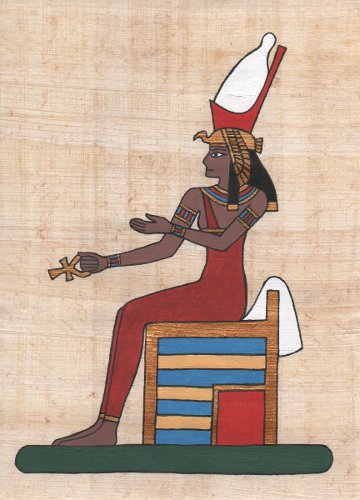
Papyrus Painting - Mut

A picture of Mut that I painted. I thought about putting a was scepter in her empty hand. I've not seen a picture of her holding one, but since she's a queen, I think it would have made sense. But in the end, I painted her so that she's holding out her hand in a summoning gesture, calling for her follower (which would be me).


Monday, June 17, 2013

Response: What Makes a "Devout" Polytheist?

Today's topic is inspired by a post I recently read on The Twisted Rope entitled "What Makes a 'Devout' Polytheist?" If you haven't already, you should take a few minutes to read it. Go on, I'll be here when you get back. I promise!

Her point could be summed up with these questions: "isn’t there more to your religion than the shrine you bow in front of? Isn’t there more than one way to show your devotion to the gods and the religion that they are a part of?" She talks about things like blogging and writing, community building (both online and off), crafting, or just talking to other polytheists about religion and gods as a form of devotion. And all of those can be just as meaningful as sitting in front of a shrine. Yes, spending time at your shrine is important, but devotion is something that you live in all aspects of your life. Otherwise your spirituality looks something like that of the anecdotal Christian who attends church every Sunday, yet acts in a decidedly un-Christian manner the other 167 hours of the week.

I know that for my part, my devotion is shown in the adoration I feel towards my gods, in the sense of peace and joy I feel whenever I glance across the room at my shrines. It is a simple, but profound experience every time.

While I more or less agree with everything that Devo said, one important thing that she didn't touch on is that (in my opinion) a big part of devotion is the way in which you treat your gods, inside ritual and out. Being a polytheist means viewing the gods as independent, distinct beings - and treating them as such. I believe that the gods care about us; they want us to be happy and whole, and they can help us to become so. However, this does not mean that the gods exist simply to please us or solve our problems. You shouldn't go to them with offerings and praise only when you want something in return, because the gods are not your personal biatches. In that sense, being devout is being able to honor the gods just for the sake of honoring them.

The other significant point here is that Devo (rightly so) differentiates between the devotional responsibilities between priests and laypeople. And that difference is what I really got hung up on.

For much of my life, I have wanted to be a priest. Even when I was a little girl and Catholicism was all I knew, I wanted to be a nun. A life of devotion to one's god and service to one's community is an intimidating prospect, but that life is one that has always been extremely appealing to me.

So where does that leave a polytheist wannabe-priest? More to the point, where does that leave the misfit tri-pantheon polytheist wannabe-priest? Can I be a priest of three pantheons at once, or do I need to pick a primary one to be a priest of? What do you do when you feel like you have no one community to call your own? Can I call myself a priest when I serve the gods but no community?

Among my friends, I have described myself as being my own priest, but I mean that in only the most matter-of-fact way. I literally do act as my own priest in the majority of my life and spirituality. But what does that even matter in a religious group filled to the brim with self-described priests?

So that's what Devo's post did to me. It reminded me for the hundredth time what a weird half-place I'm in. I enjoy ritual more than many things in my life (despite the fact that it is a chore on occasion). Aside from the good it does the gods, ritual is fulfilling and it brings me peace. As cheesy as it might sound, I really do feel like it is a way in which I am meant to bring some small bit of ma'at into not only my life, but into... well, everything. I try to do ritual and give offerings every day, and I often succeed. But I also fail miserably at times, so where does that leave me? I think of being a priest as a lifestyle, a profession, something that you not only want to fulfill, but are obligated to. But is that even possible - or more importantly, fair - when I also need to make a living and may not be able to put as much time into a priesthood as I feel I need to?

Dear Deithe, Iluma, and Netjeru, I feel so hopeless sometimes!


Tuesday, May 21, 2013

Diancecht Is Not a Jerk

A while back, a well-meaning friend gave me a book called "A Druid's Herbal for the Sacred Earth Year." While I have to admit that the book does have some useful information as far as herbology goes, the mythological and theological approach the author took was frustrating, to say the least. I can't help it; anytime someone goes around saying that Morrighan is a triple goddess, I kind of want to smack them. (She isn't. The triple goddess concept is not Celtic.)

Now, I could continue to pick apart all the nonsense the author said about Morrighan, but I'll settle for telling you that if you decide to read or have read that book, you
might as well disregard everything the author says about Morrighan. Today, there's another deity I feel I need to stand up for. And that god is Diancecht.

Poor Diancecht has such a bad reputation. In the retelling of his story in "A Druid's Herbal," as well as retellings I've heard many other Pagans repeat, it's the same thing. "He's angry! He's jealous! He murdered his son!" Ok, so that last one may be true, but that's not what I'm going to focus on at the moment. It is the words "angry" and "jealous" that I get hung up on when people try to tell his myth, and I'm going to try to explain why.

The story in question occurs after the battle between the Tuatha Dé Danann and the Fir Bolg. Nuadu's hand had been cut off, and Diancecht created for him a new one made of silver, which had the movement of a real hand. However, Diancecht's son Miach wasn't at all satisfied with this cure. Miach restored Nuadu's severed hand, healing the king. It is at this point that Diancecht seems to loose his shit. He threw his sword at Miach's head, cutting into the flesh. Miach healed himself, and Diancecht struck him again, this time cutting into the bone. Again Miach healed himself, and for a third time Diancecht struck him, cutting into his brain and killing him instantly. Diancecht buried his son, and 365 herbs grew from the grave, the same number as the joints and sinews of his body. At that point Airmed, Diancecht's daughter and Miach's sister, spread her cloak on the ground and picked and sorted the herbs according to their properties. Diancecht then mixed up all of the herbs, so that no one knows all of their healing properties.

Now I'm going to talk about the texts themselves, how I interpret them, and why. If you want to read them for yourself, translations can be found here and here.


Regarding Diancecht's "jealousy" about Nuadu's newly healed hand, one of the texts says simply that "Dian Cecht did not like that cure." Another says "But Diancecht was vexed when he saw his son doing a better cure, than himself..." Admittedly, it is an argument of semantics to say that Diancecht's annoyance at his son doing better cure isn't the same as saying that he was jealous of it, but I will take on that argument.

In this story, I look at Diancechet as a god of doctors, healers, and physicians. Miach is also a god of healing, but more than that, I see him as a god of regeneration. Therefore, to say that Diancecht was annoyed by his son's cure or that he simply didn't like it, is a mythological statement of fact. Humans cannot regenerate missing appendages. Until recently, reattaching missing body parts was a medical impossibility, and even now the process is iffy. This is why I say Diancecht's dislike of Miach's cure was not borne of jealousy. It is simply a statement that Miach's cure was something outside the scope of human ability.

So how do you get from disliking something that someone does, to repeatedly hurling a sword at that someone's head? Well, for one thing, I think this is another exploration of human ability. Flesh wounds and broken bones can heal on their own, barring any sort of infection, but once you damage the brain, you're pretty much screwed unless you have immediate and extensive medical care. In some movies, damaging the brain is even how you kill zombies, like in "Shaun of the Dead." Remove the head or destroy the brain, right?

More significantly, I see this as a sort of origin story of healing herbs. Just think about it - from the grave of the god of healing and regeneration comes 365 herbs, each corresponding to his body parts. In a mythological sense, the herbs that heal us could have only come from there. And in this sense, Diancecht's act is one of necessity, for without the felling and burial of Miach, we would have no medicine. Likewise, I see Diancecht's scattering of Aired's collection of these herbs as an explanation of their complexity. Being a competent herbologist takes years of study, and even so, no matter how experienced you are, there is always more to learn and discover.

Some may think that my interpretation of this myth is a stretch, but one has to remember that mythology is metaphor. In my experience, myths are about more than they appear to be on the surface. So the next time you tell this story, or hear someone else doing so, please don't be so hard on Diancecht. He is not a villain. He is one of the Tuatha Dé Danann. He is a god.

Tuesday, April 16, 2013

And Then There Was ‘Anatu and ‘Athtartu

Or, "Why Kaif is a Big Fat God Slut."

Some time ago, I stumbled across Tess Dawson's website, Natib Qadish: Modern Canaanite Polytheism. After poking around a bit, I found a brief description of the goddess ‘Anatu, a deity of war and loyalty. She was described as being young, fierce and fearless, and ready to defend those she cares about.

Despite how short the description of ‘Anatu was, it really made an impression on me. The feeling I got reading about her was kind of like the feeling you get when you meet some one new, and know instantly that you're going to be friends. Needless to say, I was immediately hooked, and eager to learn more about this deity. Yet at the same time, I must admit that part of me was a little frustrated as well. I had just gotten a handle on my Kemetic goings-on and wanted to continue to focus on that, to continue to nurture the relationships that I had spent roughly a year developing. However, the feeling I got about ‘Anatu was one I had learned not to ignore. After some extensive internal debate, and some reassurances to and from the Netjeru, I eventually managed to strike a compromise with myself. My immersion into Canaanite polytheism or Natib Qadish was a slow process as I learned about ‘Anatu and her fellow Caananite gods, culture, and religion bit by bit, while still keeping the focus on further establishing my Kemetic practices.

Eventually, ‘Athtartu started creeping into my mind as well. Tess Dawson's website describes her as "a goddess of compassion, restraint, and peace," and a goddess of justice. In other words, very different from ‘Anatu! It confused me a great deal that these two very different deities were both so appealing to me (or that I was so appealing to them, whichever the case may be), but I eventually learned that according to legend, ‘Athtartu and ‘Anatu were friends and would go hunting together. Discovering that was one of those beautiful moments when your own intuition can be validated by research, and that's when their connection really clicked for me. It is difficult to put into words as this understanding is so visceral, but it's about the wholeness of two seemingly separate and opposing parts. They are the warrior and the diplomat; the need to fight or make peace, act or react, and to me, together they represent the need and the wisdom to take the appropriate action at the appropriate time. This insight gave sense to my fascination with these goddesses, since one of the things I've struggled with all my life is knowing when to push and when to pull.

I recently decided to take the plunge and give the goddesses a shrine of their own, and begin some sort of formal practice for them. Despite my limited skill, I had previously made statues for them. ‘Anatu is in a smiting pose similar to those of other Canaanite warrior deities, holding a spear in hand, and ‘Athtartu is in a gentle pose, sporting the prominent pubic triangle with which she is often identified. I put these statues on a shelf with some modest decoration, and while it's a simple shrine, I like the result:

The shrine of ‘Anatu (on the left) and ‘Athtartu (on the right), with offerings of a candle, incense, and water.

If you are interested  Cananite Polytheism, check out Natib Qadish: Modern Canaanite Polytheism and Kinaʻani: Impressions of Tess Dawson, Canaanite Polytheist. For more information about ‘Anatu and ‘Athtartu specifically, read "Oh My Goddess-es: Identities of Inanna, Astarte, Ishtar, ‘Athtartu, ‘Anatu, and Athiratu" to learn more about them.  :)

Tuesday, March 26, 2013

Heka, Masaru Emoto Style

I thought this video would make a good follow-up to my previous heka post. It is a brief yet brilliant summary of Masaru Emoto's work. For those of you who are unfamiliar with it, in a nutshell, Mr. Emoto took pictures of water molecules after they had been exposed to various words and intentions. I first heard of Masaru Emoto's work several years ago, but didn't give it much thought then. However, coming to Kemeticism and learning about the concept of heka gave me a new perspective on what he has done, as well as a great appreciation for it. Just watch this video, and you can see why.


Remember, words have the power to create. They have the power to heal. Saying so is not just fluffy nonsense - it's true!

Monday, February 11, 2013

Moon Ritual

As a followup to my sun ritual, I want to share with you a moon ritual as well. Because of my Irish Celtic focus, I always sing the following song for Boann, but it can work for any lunar goddess, such as Selene.

Simply go out into the light of the moon (a full one is most appropriate, I think!), light some incense and a candle, sing, and pray.

Welcome to you,
Jewel of the night!

Beauty of the heavens,
Jewel of the night!

Mother of the stars,
Jewel of the night!

Fosterling of the sun,
Jewel of the night!

Majesty of the stars,
Jewel of the night!
Jewel of the night!


Monday, January 21, 2013

A Sun Ritual

Sometimes, the simplest rituals are the most meaningful. Imagine going outside at dawn, lighting some incense, and then singing a song of praise to the sun as it rises....

I want to share with you a song I learned during my time at the temple. It can be used as I describe above, the crown of a simple outdoor ceremony, or integrated into a more elaborate ritual of any style. The song (and accompanying ritual, if you wish) is perfect to perform at sunrise or on the winter solstice. Or whenever the mood strikes you. I often sing it on cold days when the sun has come out to warm me up. In fact, because I enjoy singing it so much, I frequently find myself singing it just for the hell of it!

So here it is, "The Sun":

Welcome to you, O Sun of the Season!
You, walking high in the heavens,
your footsteps strong on the wings of the heights;
you, the adored Mother of the Stars.

You lie down in the destructive ocean
without misfortune and without fear;
you rise up on the forked wave of peace,
a queenly maiden blooming.


Tuesday, December 18, 2012

Reconnecting

In June 2011, Temple of the River closed. It was my spiritual home for nearly six years, and while I learned many amazing things and met one of my best friends there, by the time its doors closed, I must admit that I was somewhat relieved to see it's demise. For a number of reasons, the last couple of years at the temple were very difficult for me. Its focus became so external that, as a result, my own energy was spent promoting the temple rather than nurturing my own spirituality. It happened so slowly that I didn't notice it until one day I just realized how utterly disconnected I felt from my practice and my gods. Still, I continued. For all the other troubles there were, I believed in what the temple was doing, and I wanted it to go on. But things continued to decline, and my spirituality continued to feel more and more hollow. My connection with my gods continued to wane. And still, because of my loyalty, because of everything that I had learned, I continued. And then one day, my then-teacher sent me an email, saying that, "Tonight I felt a great outrage from the Mórríghan. I have spoken closely with Lugh and Mórríghan about your apprenticeship and they are quite clear that you are out of second chances."

As I said, by that point, I had almost no remaining connection to my gods. And whatever was left was shattered by that declaration. Despite the fact that part of me knew how ridiculous his claim was, the other part of me, the part that was still the submissive student, figured that he had to be right. He knew a lot of things, had been my trusted teacher and priest for years. If anyone could know such a thing, it had to be him, right? The sensible part told myself that if this was correct, Morrighan herself would have told me so - and yet I felt no such outrage. But on the other hand, I wasn't feeling much of anything. The frightened part of myself said the silence was proof that Morrighan had to be pissed off at me. She was pissed off because I was ignoring her, because I was a terrible student, and because I was being whiny and weak for not doing more for the temple, despite all I had already given and how exhausted and strained I had become. I was a failure, plain and simple. I was not worth Morrighan's time. I was not worth any god's time.

For a couple of months after I left the temple, my spirituality was more or less nonexistent. The gods and the lore were always in the back of my mind, but I couldn't bring myself to do much of anything about it. There were still too many wounds that were still too fresh. Then I got into Kemetic religion, and learning about something so different helped to ease me back into a spiritual state of being. As a result, I was able to make more of an effort to reestablish a connection with my Celtic beliefs and practices. It wasn't much; an Imbolc celebration here, a little offering there, and maybe a couple of prayers in between. Still, there wasn't much feedback. By the time I wrote this post, I had realized that my Celtic practices still carried too many negative associations from my time at the temple, and thus decided to set them aside altogether to focus on my Kemetic ones. That post was a dedication to Morrighan and An Badb Cath before I went on my way, in case I would never be able to return to them.

Then something amazing happened. Last week, I felt a calling. I sat down in front of my long-neglected Celtic altar, and felt inspired to make offerings to Morrighan. It had been months since I had done any such thing, and the feeling I got from her was unlike anything I'd experienced before. In most ways she was the same; Morrighan's presence always felt to me like I was being wrapped in a darkness that was all at once beautiful, powerful, and comforting. But this time there was something more. There was a loving, caring, warm welcome. I was the child, confused and unhappy, who had to go her own way for a while; she was the mother who let me go, knowing that I had to have my own adventures and make my own mistakes. That offering was the homecoming. She welcomed me with a hug and a glad heart, as if to say, "you're finally here. I've been waiting for you, and I'm so happy to have you back. Welcome home!"

I finally feel like I can return to my Celtic practices. They feel new, and whole, and most importantly, they feel like mine. I doubt that Morrighan was ever outraged at me. I don't know why my former teacher told me such a thing. Maybe he was mistaken, maybe he was projecting his own frustrations, maybe he was trying to manipulate me. I don't think I'll ever know, but at this point, it doesn't matter anymore. I believe that Morrighan wanted me to go my own way for a while and figure things out for myself. I also believe that she called me when she knew I sorted my issues out, and that she knew I'd come back. Regardless of what happened at the temple, or what baggage it left me with, I know now that Morrighan is indeed my goddess, and that I am her child. I know that she wants me around, that she loves me. I see now that the rough road was worth it for this affirmation.

The reason I am sharing all of this is not to air my dirty laundry on a public forum. I have said the things that I have said only because they are a part of my story of uncertainty and disconnection. I have said the things I have said to show how shattered my faith had become, and subsequently, how it became restored. I have said these things with the hope of encouraging my fellow Pagans. Everyone goes through moments of spiritual dissonance. Sometimes they are severe and persistent, sometimes they have a singular cause, sometimes they seem to come from nowhere. Sometimes overcoming them requires patience and persistence, sometimes it requires going another way for a while. All we can do in the meantime is remind ourselves that spiritual life is a journey. Sometimes we get lost (or only think we get lost), but all we can do is keep going. It is only when we've stopped that we've truly lost our way.


Praise to The Great Queen!

Monday, December 3, 2012

Papyrus Painting - Serqet

Here is a picture of Serqet that I painted for one of my friends for her birthday. Because blasphemy is fun, I took the liberty of depicting the scorpion atop her head in a more lifelike fashion, rather than the stingerless, legless manner it usually is.


Serqet, She Who Causes the Throat to Breathe